
Article and Photos by Lee Daley.
Memories of my Equestrian travel in Ireland’s southwest coastal region often pop into mind. Whenever I reflect back on this first visit to Ireland, my thoughts follow a stream of consciousness that flows effortlessly. The past becomes the present, and I am there once again. My stay at the ancient Kinnitty Castle in the foothills of the Slieve Bloom Mountains introduced me to the beauty of Ireland’s natural world.
Soon after my arrival, an almost film-like experience occurs. Arriving much earlier than others in my small group, I wander downhill to Kinnitty Center and step into the local pub. With just two men occupying a nearby table, I opt to sit at the bar and order my first-ever Guinness. One of the men tilts his beret toward me and calls out, “Hello, hello. Where are you stayin’?” To my answer, he responds. “Aye. Lassie, there’s no hassle in Kinnitty Castle.” My Guinness soon arrives. Dark and dense. Strong and bitter, I could not refrain from a slight cough after swallowing the first sip. Watching with a friendly air, my new friend smiles and says, “Aye, lassie, having a Guinness is like eatin’ and drinkin’ at the same time.” No question, I have experienced a warm welcome into the village of Kinnitty.
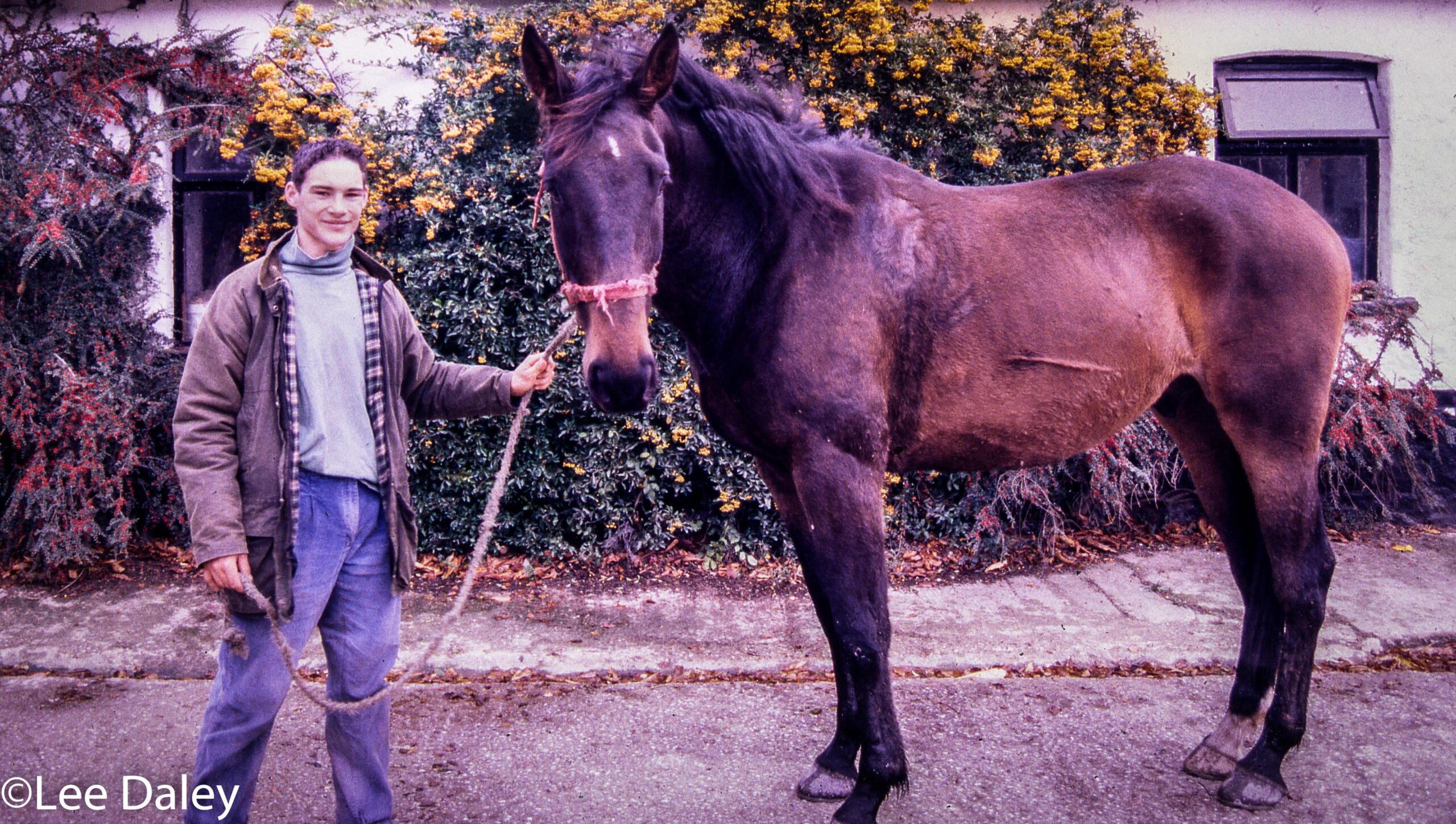
Your horse awaits you at Kinnitty Castle Equestrian Center.
Heading back to the castle, I revisit my concerns. Like many other decisions in life, my impetuousness has gotten the better of me. It’s been decades since my riding lessons, which took place prior to my teenage years. I tell myself that the luck of the Irish will somehow see me through, and the thrill of once more riding along with the glorious sense of freedom that comes with horse back riding will emerge naturally, and so, the adventure is about to begin.
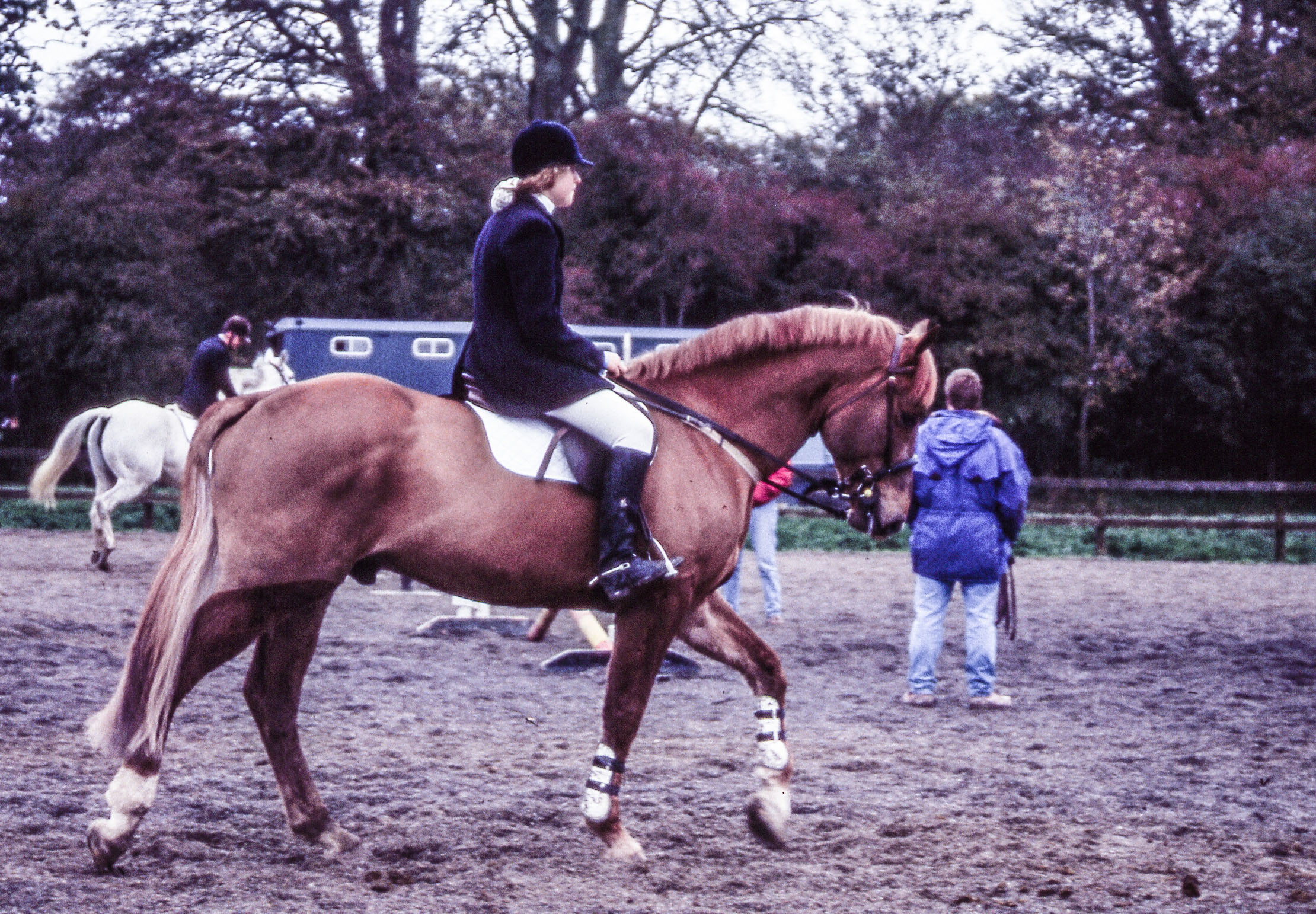
Kinnitty Castle paddock
At dawn the next morning, rain lashes the windows of my second-floor bedroom in Kinnitty Castle. The Castle Clarion has predicted a “soft morning.” That’s Irishese for “overcast with intermittent showers.” I pull on breeches and paddock boots, grab my Gore-Tex rain gear, and stumble down the grand staircase, out the castle doors to the stables.
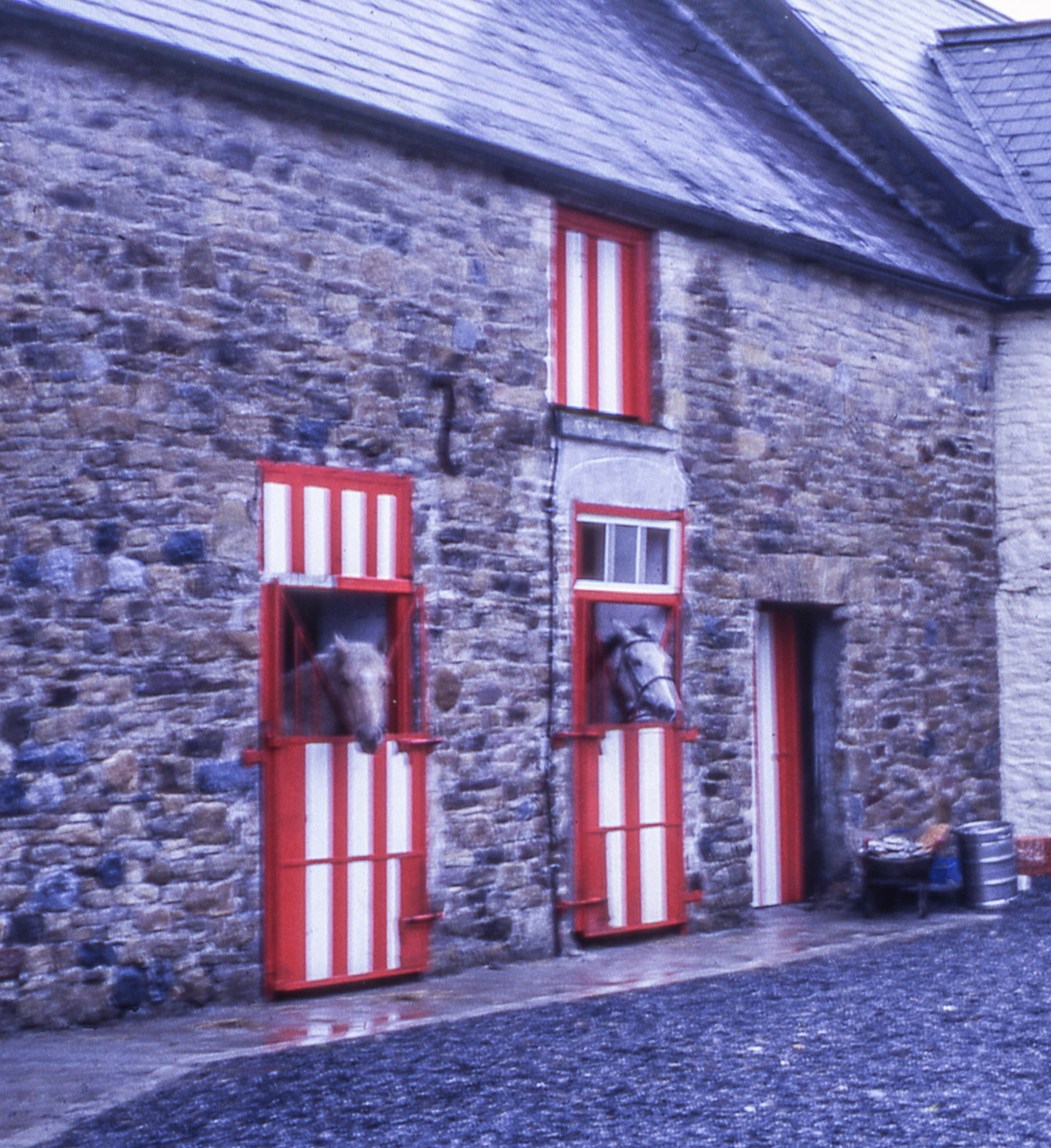
Kinnitty stables
Behind the barn, the horses are lined up, exhaling clouds of morning breath at the feeding troughs. Unlike the shaggy Connemara ponies we will be riding in a few days, the coats and form of these elegant mahogany hunters are as sleek as those of show horses. I feel about as nervous as a stallion on the morning of the Preakness. In minutes, I will be high in the saddle, and it has been years since I’ve been within so much as trotting distance of a stable. Rather than the surge of confidence I first felt when I signed on for a week of group trail rides through the hills of Ireland, I struggle to overcome a siege of skittishness.
After a few warm-up turns in the paddock, our group takes to the woods surrounding the castle. My sturdy steed, Dancer, proves himself a gracious mount for our morning canter. Wide trails invite long gallops. Invigorated, I realize I haven’t flown across the Atlantic for a mere trail ride. I squeeze Dancer’s sides firmly, and we’re off. As far as the eye can see are broad hillsides dotted with ancient yews and oaks. At times, all seven riders and horses canter along together. Then, distances between us become so great that the other riders become specks of motion in the distance. Soon, the path narrows as it winds deeper into the woods, skirting the banks of a meandering stream. Thickly leafed boughs bend and curve forming a sheltered bower, and I am alone but for the sounds of horses’ hooves and a soft, warm rain. A feeling of freedom fills me. We soon emerge out of the thicket into a clearing, and Dancer, eager to join the other horses, breaks into a full gallop. I feel fulfilled.
Back at the barn, we relinquish the horses’ reins to waiting stable hands. I limp into the library and collapse into a leather armchair by the fireplace. Pleased with the morning’s performance, I join our guide, Karen, for a warming cup of hot tea before excusing myself to partake of a long luxurious soak in the claw-footed bathtub in my room.
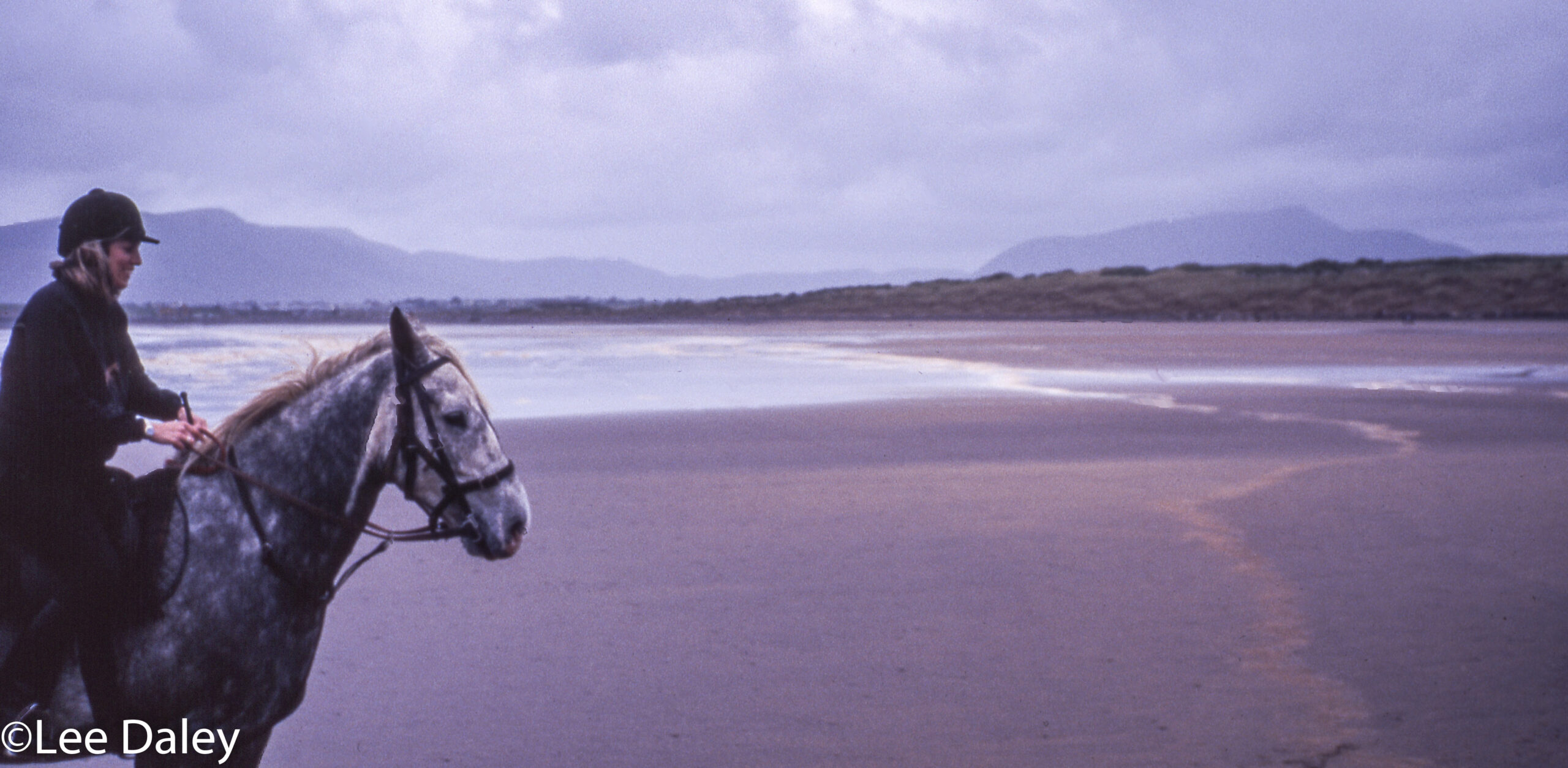
Each portion of the trip brings unexpected challenges and pleasures. From our sojourn at Kinnitty, we drive to Killarney, where we meet stable master Donie O’Sullivan, who will lead the longest ride of our trip, a trot to Waterville, where we take vigorous canters on the beach between intermittent rain showers. At midday, our caravan clip-clops into the village of Waterville in a driving rainstorm. We shelter and tie the horses, gentle, strong Connemara ponies, to a rail behind the town pub and wait out the storm with hot toddies, fish, and chips.
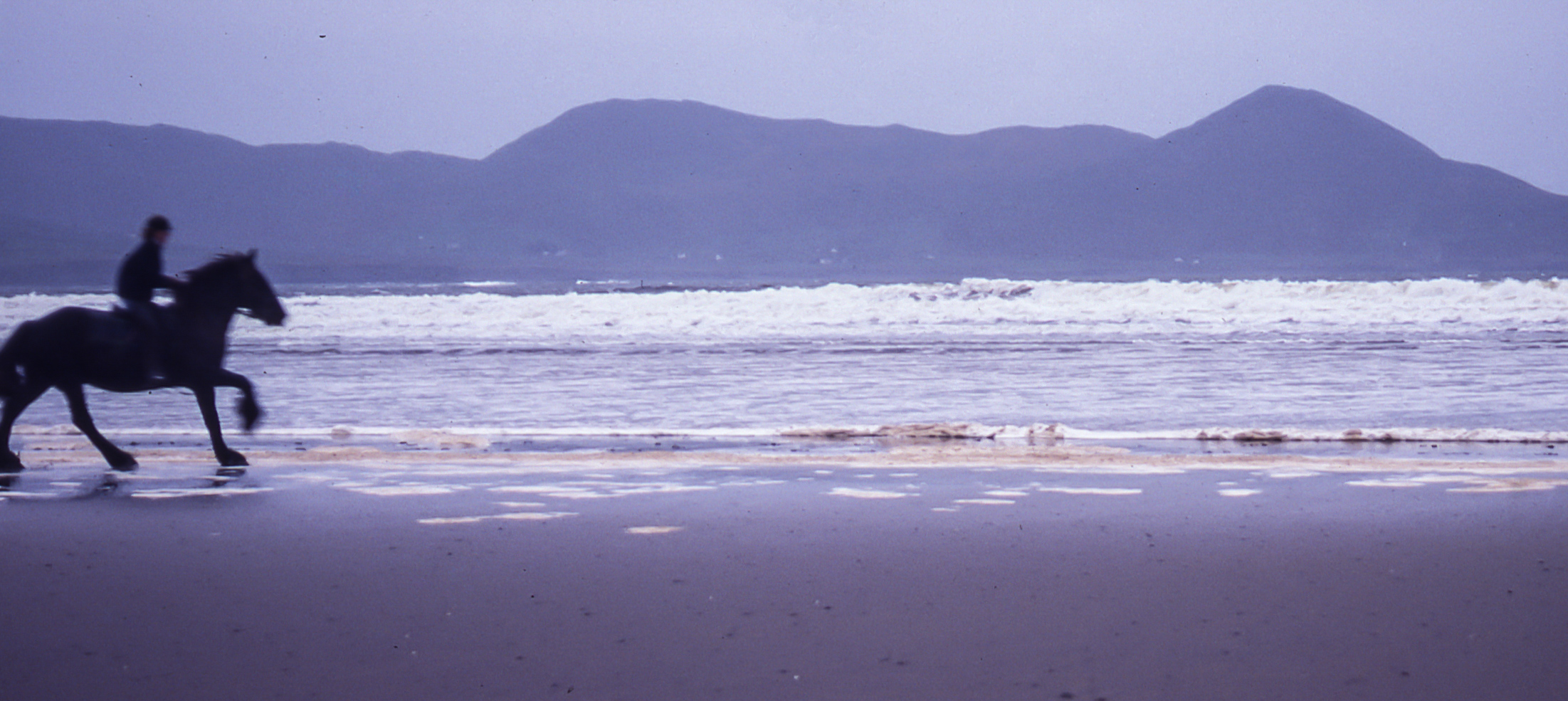
A canter on the rain-enhanced beach
By mid-afternoon, we again don our chaps, waterproof slickers, rubber boots, and gloves before climbing back in the saddle just in time to be greeted by an extended burst of sunshine. Well outfitted as we are, the rain has added to our adventure. Now, with the sun on our backs, the Connemara recover their energy, and the afternoon beach run becomes a fitting climax to a full day.
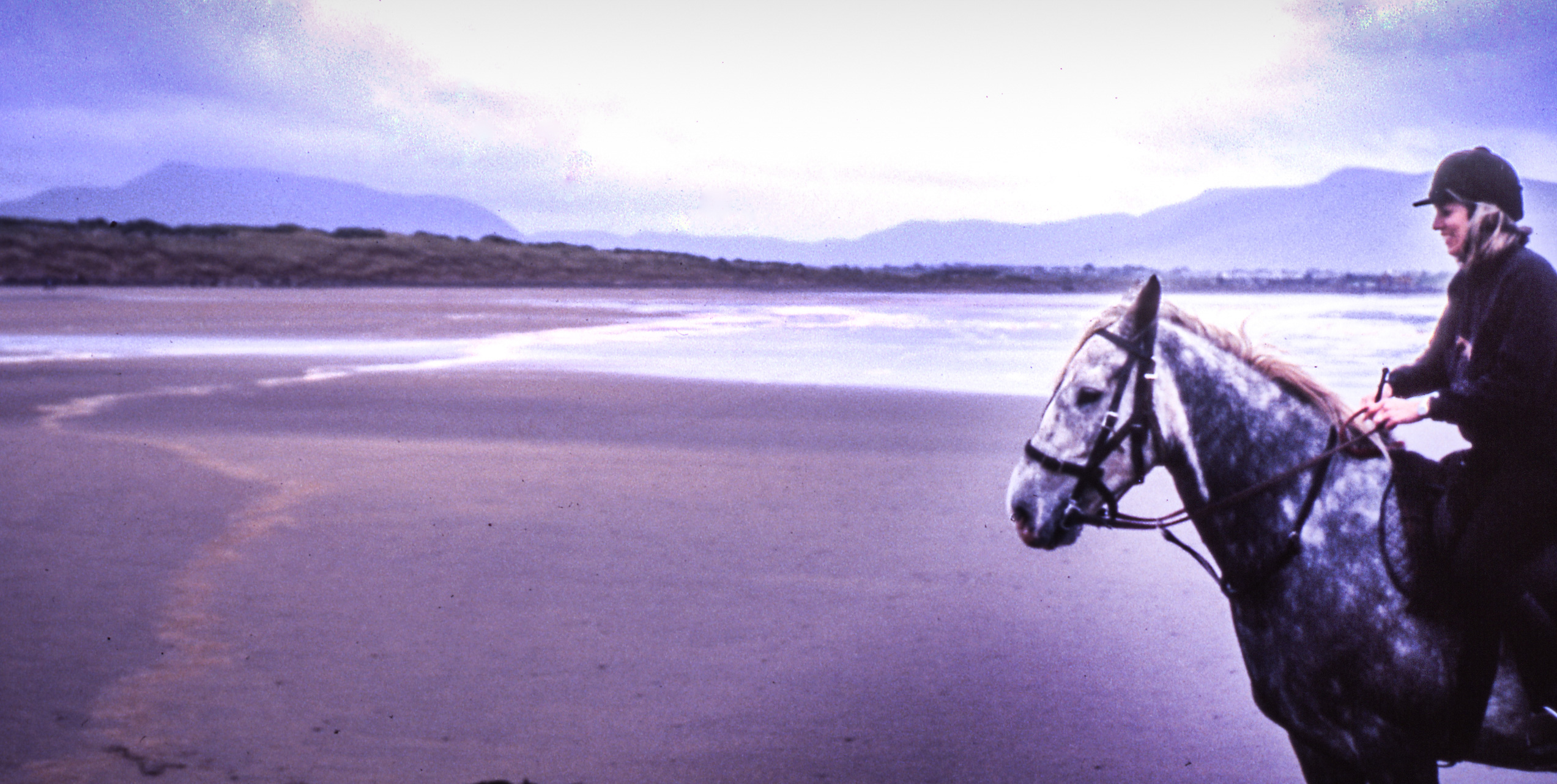
Connemara ponies with the sun at our backs
With just two days left, we move on to the Clonshire Equestrian Center, outside Adare. Clonshire specializes in all sorts of riding lessons, including cross-country, dressage, and show work. Sue Foley, the young, bright-eyed founder of Clonshire, holds a degree in stable management and riding instruction from the British Horse Society. Her specialty is jumping. Jumps, I learn, come in many forms.
The type of jumping Sue has in mind for our group is hunt jumping, which involves jumping over obstacles like stone walls, ditches, timber fences, and the challenging meadow berns called Irish banks. While I have no intention of hunting, I find the prospect of actually jumping both exhilarating and terrifying. “It’s not a problem,” Sue says to us neophytes. “It’s just a wee bit of a bar. You will be jumping in no time.”
Sue starts us off with a run in the soft green meadow outside the barns. Soon, the skilled riders, experienced jumpers that they are, begin scaling the three-foot-high timber fences with ease. Following Sue’s instructions, I attempt my virgin jump. I urge Echo, my brave Irish thoroughbred, into a canter as we approach the low crossbar designed for beginners. Echo stops, stock-still, and refuses to move. “You’ve got to push him. He knows your heart’s not in it. He needs your confidence. Push him, and he’ll jump,” Sue coaches. Mustering all my skill and nerve, I trot Echo in a wide circle, eyeing the stone wall at the far side of the field. “Go for it!” Sue shouts. I give myself plenty of running room to build up speed, clucking confidently to Echo. I lean forward with Echo giving it his all.
We reach the point of no return. I take a deep breath and launch him up and over the stone wall. The experience is one of panic, excitement, and terror, followed by a rush of unbridled elation as we gallop across the field. All my skittishness gone, I give Echo a grateful pat, several hugs, and a blown kiss. After the glory of the jump, I feel ecstatic and consider the possibility of extending my stay for another week in the countryside, researching my Irish roots. After all, we Irish have never let a stone wall or a wee bit of rain stand in our way. And we never will.
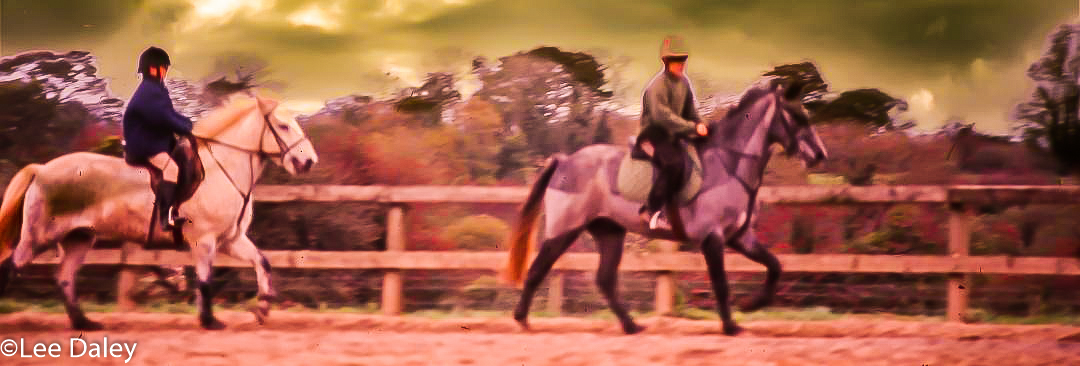
An evening trot on handsome steeds.
The ideal Irish horse is brave, kind, willing and sensitive; actually the ideal partner, known for being comfortable and often described as being “safe with soul.” For these reasons, Irish children often sit astride ponies as early as 3-5 years of age. The country’s love of horses runs both rural and urban with a relationship that is often one of kinship.
Kinnitty Castle: Guests can take a 1-hour trek through the Slieve Bloom Mountains with Birr Equestrian. Treks can be tailored to suit individual needs. For families with children, Kinnitty Castle Hotel features a magical Fairy Trail through the woodlands that overlook the meadows that are interspersed with woodland creatures such as wild horses and deer. Shhh.. don’t wake the Fairies!
In addition, the hotel has its own tarmacked tennis court for all guests to enjoy. Tennis rackets and balls are available complimentary.
Dining: Guests can enjoy a variety of excellently prepared dishes in Kinnitty;s Slí Dala Restaurant, light refreshments and relaxing drinks in the Library Bar or traditional food and drinks in the Dungeon Bar.
Guinness: Despite my “not perfect” initial taste of Guinness, I now concede to Anthony Bourdain’s educated opinion: “This delicious, some say magical, brew is so tasty, creamy, so near chocolatey in its rich,
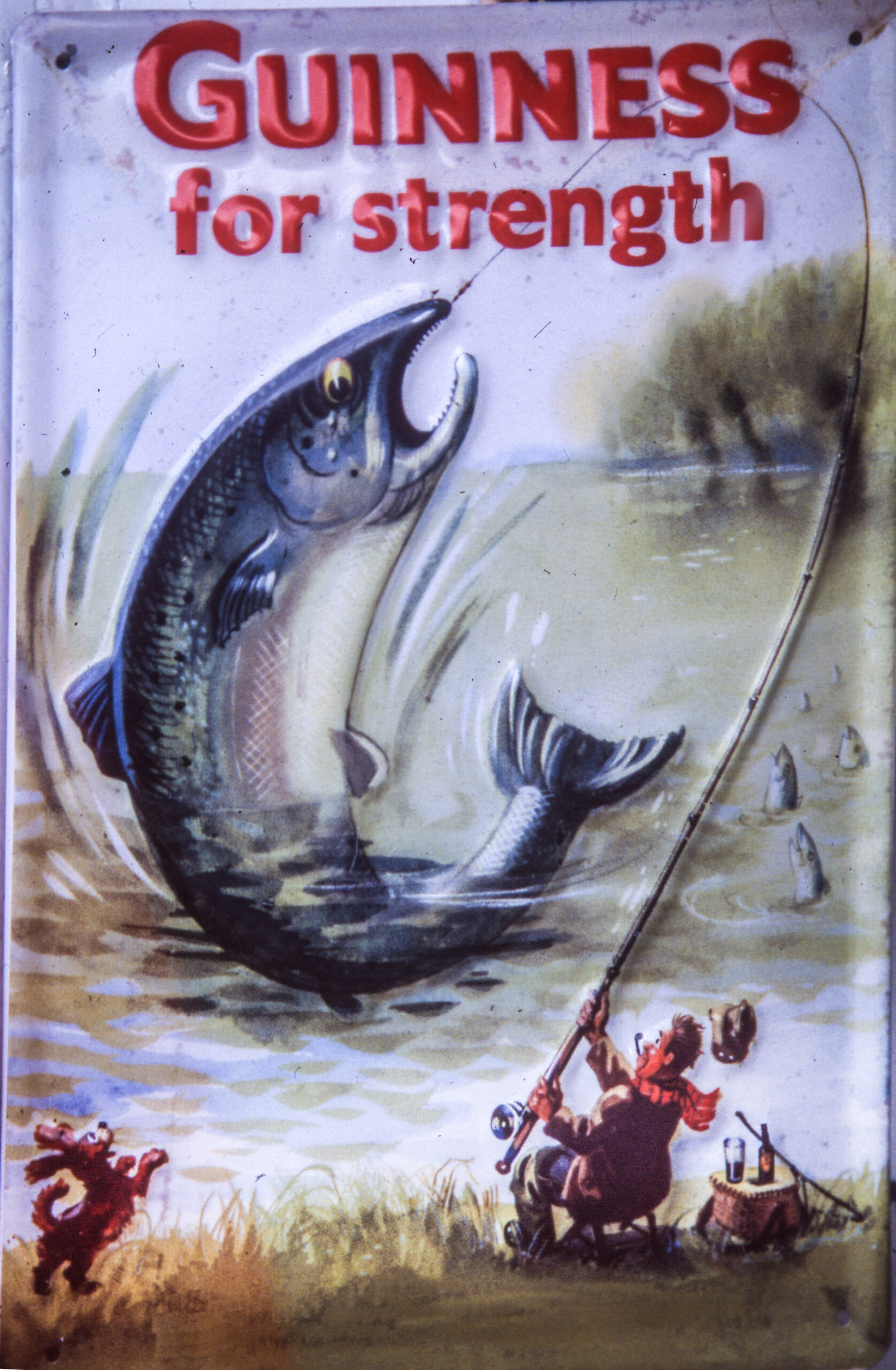
A historic Guinness poster
satisfying, buss-giving qualities, that the difference between the stuff here, and what you get where you come from, is like night and day. One is beer; the other, angels sing celestial trombones.” Bourdain’s description has a touch of Irish poetry in it, for sure.
“May the road rise up to meet you. May the wind always be at your back.”


2 Comments
Lee,
Your article makes me want to jet off to Ireland, though my horseback riding days are long past. Beautiful photos. Is one of the photos of a Lassie on the horse you? I love your poetic conclusion about Guinness. I guess I will have to try it.
Very exciting. Lots of questions but I loved the jumping narrative.